
Do you smoke and are you over 45? Then you may be wondering why you need a medical exam before you’re allowed to dive. The short answer: diving puts strain on your heart and lungs, and both smoking and older age increase the risk of problems that can be dangerous underwater. In this blog, I explain what smoking does to your heart and lungs, what role Boyle’s law plays, and what I check during a dive medical exam on Bonaire.
I’m regularly asked: ‘Why do I need a dive medical exam if I smoke and I’m over 45?’ People also ask me why smoking is relevant to diving safety at all.
During a dive, the body is exposed to changes in pressure and to physiological conditions that can put extra strain on the heart and lungs. Diving can also require physical exertion, for example when swimming against a current or performing an emergency procedure. That’s why it’s important that your cardiovascular and respiratory systems function well enough.
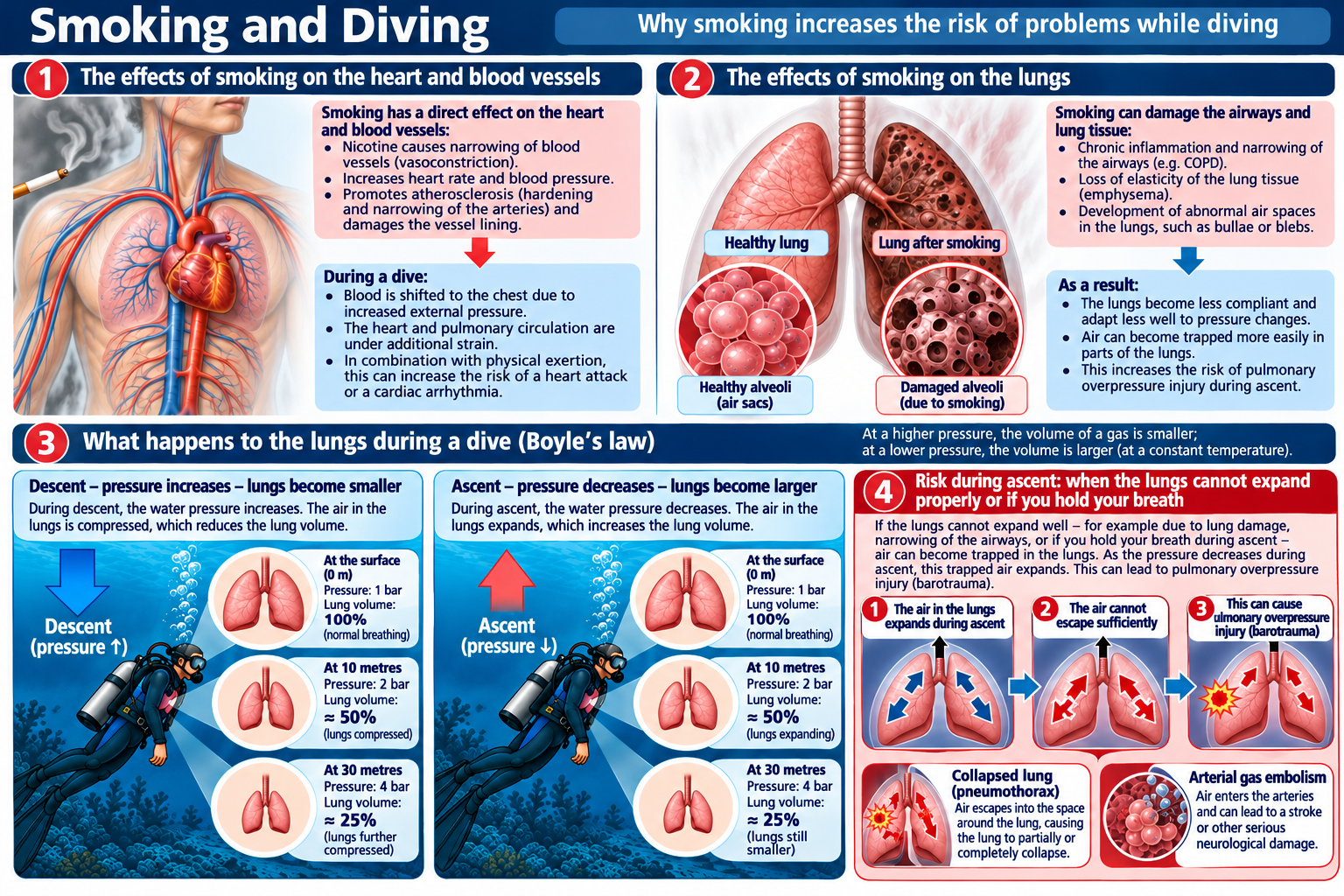
How smoking affects the heart and blood vessels
Smoking increases the risk of cardiovascular disease. Among other things, nicotine causes a temporary narrowing of the blood vessels and a rise in heart rate and blood pressure. Smoking also promotes the development of atherosclerosis (hardening of the arteries) and damages the inner lining of the blood vessels.
When you’re immersed in water, blood shifts from the limbs to the chest. This increases the blood volume in the chest and puts extra strain on the heart and the pulmonary circulation. Combined with physical exertion, this can increase the workload on the heart even further.
In someone who smokes and also has, for example, high blood pressure, atherosclerosis or high cholesterol, the risk of cardiovascular problems may be higher. A heart attack or heart rhythm disorder underwater can have serious consequences, because the diver may lose consciousness and drown.
How smoking affects the lungs
Smoking can damage the airways and lung tissue. Long-term exposure can lead to chronic inflammation, narrowing of the airways and emphysema, among other conditions. In emphysema, the walls between the air sacs break down, reducing the elasticity of the lung tissue. Abnormal air spaces, such as bullae or blebs, can also develop.
These changes matter for diving because of Boyle’s law. According to this law, the volume of a gas increases when the surrounding pressure decreases, provided the temperature stays the same.
During descent, the surrounding pressure increases and the gas volume decreases. During ascent, the surrounding pressure decreases and the gas expands. Normally, this air can escape through the airways as you ascend.
However, when air becomes trapped, for example due to narrowed airways, air trapping or holding your breath, the pressure in certain parts of the lungs can rise too high. This can cause lung overexpansion injury (pulmonary barotrauma). Possible consequences include a collapsed lung (pneumothorax) or an arterial gas embolism, in which air enters the arteries and can cause neurological damage, among other things.
Smoking increases the risk of lung damage, but not every smoker develops COPD or abnormalities that make diving unsafe. Conversely, relevant lung abnormalities can also occur in people who have never smoked.
Why does a dive medical exam matter from age 45?
As we get older, the risk of cardiovascular disease increases on average. Smoking is an additional risk factor. That’s why certain diving medicine guidelines recommend paying extra attention to cardiovascular health from age 45. This age limit is based on risk assessment and is not a universal rule that applies the same way in every situation.
What happens during the dive medical exam?
During a dive medical exam, I look at your medical history, any symptoms, your physical condition and your risk factors for cardiovascular disease. We also do a lung function test.
A lung function test can help detect signs of narrowed airways or reduced lung function. However, the test cannot detect or rule out all structural abnormalities of the lung tissue.
If abnormalities are found during the lung function test, the diver is declared unfit and diving is not permitted. Depending on the nature of the abnormalities, further examination by a pulmonologist may be recommended. Based on the results of this follow-up examination, the medical situation can be assessed in more detail.
Would you like to make an appointment for a dive medical exam? Check availability here.